
Category: Ready for launch

Trend away from death penalty on display at conservative conference in Denver

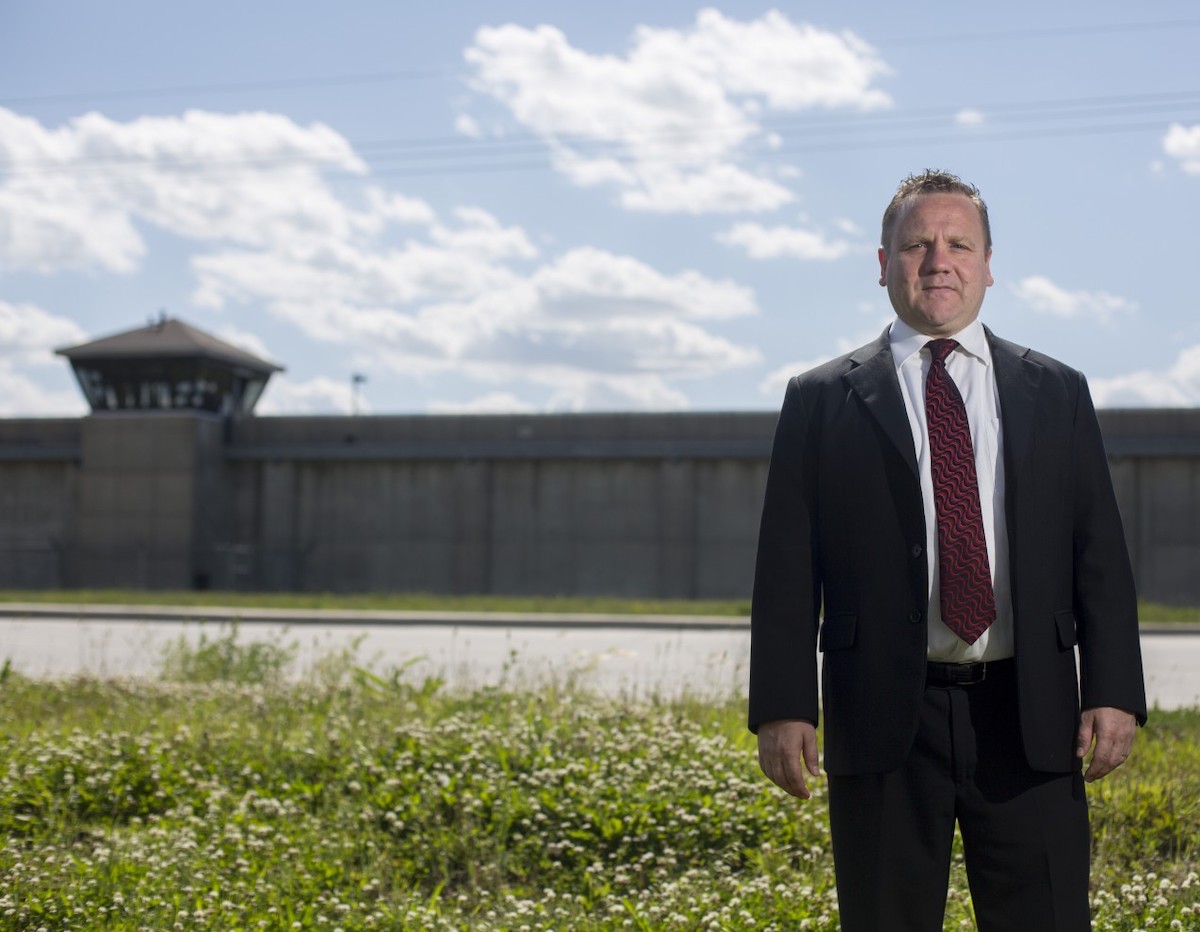
CCATDP Conference display

More than 4,000 people are expected to attend the 7th annual Western Conservative Summit, said to be the largest gathering of conservatives outside of the annual CPAC conference in Washington, DC. Also known as “Rally in the Rockies,” the 3-day event takes place this weekend in Denver.

EJUSA’s Marc Hyden will be attending the conference to talk to participants about Conservatives Concerned About the Death Penalty.

“One year ago, the conservative state of Nebraska repealed the death penalty, and earlier this year the Senate in another conservative state, Utah, voted to repeal the death penalty,” said Marc. “It’s clear that the death penalty’s support is waning, and fewer conservatives want anything to do with a broken government program that risks innocent life, hemorrhages taxpayer money, and fails to serve society or murder victims’ families.”

Stacy Anderson of Colorado’s anti-death penalty group, Better Priorities Initiative, will be joining Marc for the weekend. Motivated by her evangelical faith, Anderson led Nebraskans for Alternatives to the Death Penalty during last year’s successful repeal campaign in the Cornhusker State.

If you’re attending the conference, you can find Marc and Stacy in the exhibit area at Booth 516.
Filed under: Ready for launch

Stakeholders meet at White House to discuss race, trauma, and disrupting cycle of violence

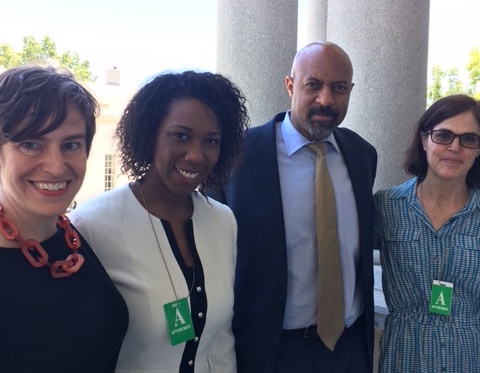
EJUSA White House delegation with Roy Austin

EJUSA staff were at the White House last week with health and violence experts, discussing the national movement to frame and address violence as a public health issue.

Executive Director Shari Silberstein, Director of the Trauma Advocacy Initiative Fatimah Loren Muhammad, and Director of Campaigns and Strategy Laura Porter (pictured with Roy Austin, Deputy Assistant to the President for the Office of Urban Affairs, Justice and Opportunity in the White House) shared EJUSA’s vision of a trauma-responsive justice system.

“It was an honor to be at the White House,” said Shari. “These are important discussions about breaking the cycle of violence and building systems that heal, instead of harm.”

At lunch, after the White House meeting
Several meeting participants enjoying lunch after leaving the White House. Clockwise from bottom left: Courtney Grey, Director, Trauma Response and Recovery, Boston Health Commission; Dorothy Johnson-Speight, Founder and Executive Director, Mothers In Charge, Philadelphia; Heather Warnken, Visiting Fellow, U.S. Department of Justice; Shari Silberstein, Executive Director, EJUSA; Fatimah Loren Muhammad, Director of Trauma Advocacy Initiative, EJUSA; Jonathan Heller, Co-Director, Human Impact Partners.

Photo credit: Dorothy Jonson-Speight, Mothers In Charge

Filed under: Ready for launch

Victim services dollars start going to communities in need

The Los Angeles Metropolitan Churches (LAM) is building a network of local churches and community groups to provide trauma-informed services to African-American, Latino, and immigrant crime survivors in South Los Angeles.

And now, for the first time, they are receiving federal VOCA funds – funds earmarked for victims services – in order to carry out their work. These funds are more than just a grant. They mark a possible turning point for crime survivors of color, who have long been underserved by the traditional victim services field.

“All too often communities of color have had to witness and endure first-hand the ills and fall-out of social programs that don’t work, public safety systems that don’t protect and serve and cycles of violence and abuse that seem to never end,” said Cheryl Branch, Executive Director of LAM.

Continue reading

Filed under: Ready for launch

Meet the red-state conservatives fighting to abolish the death penalty

Nebraska state Sen. Colby Coash

In college, Senator Colby Coash celebrated at a tailgate party outside of a prison during an execution. Now he’s part of the growing conservative movement to end the death penalty in the United States – a movement that EJUSA’s Conservatives Concerned About the Death Penalty has helped spawn. Read The Washington Post’s in-depth article about this trend and EJUSA’s impact, featuring interviews with EJUSA staff members Heather Beaudoin and Marc Hyden, who lead Conservatives Concerned.

Read the full article in The Washington Post.

Filed under: Ready for launch

Ta-Nehisi Coates on a possible death sentence in Charleston church

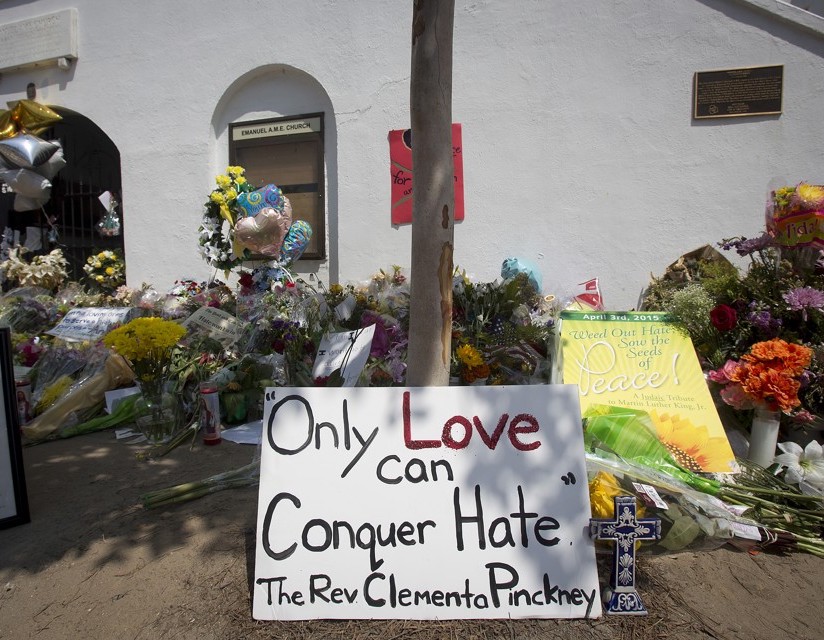
A sign is pictured at a makeshift memorial for victims of a mass shooting, outside the Emanuel African Methodist Episcopal Church in Charleston, June 22, 2015.

In June 2015, Dylann Roof allegedly killed nine African Americans in a mass shooting in a black church in Charleston last year. The families of the victims responded to the tragedy with powerful messages of forgiveness. Now, the DOJ has declared it wants to execute Roof for the crime, even though his death by lethal injection will change nothing about the conditions that lead him to violence.

Ta-Nehisi Coates offers a very powerful analysis on DOJ’s announcement to seek the death penalty for Dylann Roof.

Read the full article in The Atlantic

Photo credit: A sign is pictured at a makeshift memorial for victims of a mass shooting, outside the Emanuel African Methodist Episcopal Church in Charleston, June 22, 2015. REUTERS/Carlo Allegri

Filed under: Ready for launch

Evangelical activist Shane Claiborne shares his support for death penalty repeal in new book

Executing Grace by Shane Claiborne


Is anyone beyond redemption? What does true justice look like? Does God support capital punishment? These are a few of the questions raised in a new book, Executing Grace, by Shane Claiborne. The book was released yesterday and is available at your local (or online) bookstore.

Claiborne is a prominent Christian speaker, activist, and best-selling author. He founded The Simple Way in Philadelphia and heads up Red Letter Christians, a movement of people who are committed to living “as if Jesus meant the things he said.”

Claiborne used to support the death penalty. He believed the death penalty was ordained by God. The more he learned about the subject, the more troubled he became. He talked to victims’ families, exonerees, executioners, and his fellow Christians. He’s now convinced that the death penalty needs to end once and for all.

In Executing Grace, Claiborne explores the contrast between punitive justice and restorative justice, questioning our notions of fairness, revenge, and absolution. At times, he also dives into the Bible and into history.

“At the heart of this book are the stories, which show the human toll the death penalty is taking on us,” Claiborne says. “But it is also a book about the power of grace, forgiveness, and healing.”

EJUSA has worked with Claiborne on many occasions, including organizing events at Wheaton and Calvin colleges, presenting together at the Christian Community Development Association conference, and meeting one-on-one with Evangelical leaders to talk about redemption, racial justice, the risk of wrongful convictions, and other problems with the death penalty.

We could not be more thrilled about this book and are already in the middle of reading it!

Filed under: Ready for launch

Death penalty chaos around the country

Nevada just became the ninth death penalty state to go a decade or more without an execution. Add those nine to the 19 states without capital punishment, and you have 28 states that have abandoned executions in either law or practice.

And in the remaining states? The death penalty is in complete chaos.

Florida’s death penalty law has already been thrown out twice in 2016. The first ruling came from the U.S. Supreme Court in January. The Florida legislature then passed a “fix” to the law, and last month a Miami judge threw it out again. Alabama’s death penalty law is similar to Florida’s, and the Supreme Court sent a death sentence back for review for the third time this week because of those similarities.

Meanwhile, prosecutors in Georgia have come under fire for illegally keeping African Americans off the jury in a death penalty case. The Supreme Court overturned the sentence with a vote of 7-1. The defendant is one of many black men sentenced to die by an all-white jury across the south.

Lethal injection debacles continue as states struggle to find drugs, hide their processes in secrecy, or carry out executions with outright “systemic ineptitude.”

Oklahoma is back at the heart of the lethal injection controversy. A grand jury released 106 pages of scathing critiques last month, citing “inexcusable failures” in the state’s execution process. According to the Washington Post, the grand jury:

“…paints these officials as careless and, in some cases, reckless. The missteps described by the grand jury include a pharmacist ordering the wrong drug for executions, multiple state employees failing to notice or tell anyone about the mixup and a high-ranking official in the governor’s office urging others to carry out an execution even with the incorrect drug.”

The same secrecy and lack of oversight found in Oklahoma is common in other states, too, and has contributed to execution problems in Missouri, Georgia, and Ohio.

And now Pfizer, the last remaining, FDA-approved supplier of lethal injection drugs, declared it no longer wants to be in the execution business. Pfizer announced sweeping new restrictions on the distribution of some if its drugs, preventing them from being used in executions.

The last death penalty holdouts show that the only way to have a death penalty is to accept bias, ineptitude, and arbitrariness. It’s only a matter of time before the death penalty is gone for good.

Filed under: Ready for launch

Building a justice system rooted in healing

EJUSA is thrilled to be featured in a new publication, “A Handbook for Jewish Communities Fighting Mass Incarceration,” by the Jewish human rights organization, T’ruah. The Handbook is a comprehensive guide for action from a Jewish perspective. It contains background information on various aspects of mass incarceration, from what happens when police stop people on the streets, to conditions inside jails and prisons, to the challenges people face when they leave incarceration and attempt to rebuild their lives.

T'ruah Mass Incarceration Handbook

Our contribution, “Building a justice system rooted in healing,” is written by EJUSA Executive Director Shari Silberstein. It includes EJUSA’s unique perspective on crime survivors’ needs:

In our work to end the death penalty over the last 25 years, we’ve met and worked with hundreds of family members who have lost loved ones to murder. Some supported the death penalty and others opposed it. But what united them all was the devastating trauma they experienced in the wake of their unimaginable loss…

The assumption is that justice means punishment for someone who has done something wrong. A crime happens, law enforcement finds out who did it, the courts hand down a sentence, and the crime victim is healed.

So the story goes. The reality is much more complex.

The vast majority of crime survivors’ needs have nothing to do with what happens to the person who harmed them.

Shari goes on to outline the plethora of needs that crime victims have, beyond punishment – most of which are not addressed in policy.

Crime survivors are rarely offered more than an alienating legal process as the primary salve for their wounds.

She concludes by reminding readers that criminal justice reform and addressing mass incarceration must include

advocacy for resources and life saving services that will support survivors after tragedy strikes.

Visit T’ruah’s website to download the full handbook.


Filed under: Ready for launch

CCATDP’s Marc Hyden on Tipping Point with Liz Wheeler

Marc Hyden on Tipping Point

Last week, I was a guest on Tipping Point with Liz Wheeler to discuss Oklahoma’s damning grand jury report on their lethal injection scandal and Florida’s unconstitutional death penalty. You can watch the segment below:

Conservatives Concerned About the Death Penalty (CCATDP), a project of Equal Justice USA, is a network of political and social conservatives who question the alignment of capital punishment with conservative principles and values. For news and updates from CCATDP, join their email list.

Filed under: Ready for launch

Veterans on Death Row

NYC Bar

Tuesday, May 24, 6:30 pm – 8:30 pm NYC Bar Association, 42 West 44th St, NYC

Sponsored by the New York City Bar Association’s Committees on Capital Punishment and the Military Affairs & Justice

Although it is difficult to determine a precise number, it is estimated that approximately ten percent of the America’s 3000 Death Row inmates are veterans. This program will explore the pathology of the condemned veteran population. In particular, the mental health implications of military service and combat will be examined in in light of Supreme Court precedents such as Porter v. McCollum. Among the issues to be discussed will be the effects of Traumatic Brain Injury, Post-Traumatic Stress Disorder, and military culture. The panel will also reflect upon what factors should be considered in determining the appropriate sentence for veterans convicted of capital crimes.

Panelists:

Dr. Jerid M. Fisher is a forensic neuropsychologist with more than thirty years of experience. After working for several years at the University of Rochester Medical Center as a senior instructor in psychiatry and neurology and the director of the Cognitive Functions Laboratory, he left academia to develop brain injury rehabilitation programs across the state of New York. Fisher has specialized in high- profile litigation as a criminal expert for both the defense and prosecution. His work has brought him in contact with serial killers, persons facing the death penalty, and murderers found incompetent to stand trial due to severe brain injury.

Irina Komarovskaya, Ph.D. is the Clinic Director at the Steven A. Cohen Military Family Clinic at the NYU Langone Medical Center and a clinical assistant professor in NYU Langone Medical Center’s Department of Psychiatry. She joined and helped establish the Military Family Clinic in July 2012 and is dedicated to building a robust clinical program that delivers integrative, evidence-based, individualized treatment to veterans and their families.

Art Cody is the Legal Director of the Veterans Defense Program. His military career spanned thirty years and he is veteran of multiple combat deployments. He has represented numerous death row inmates to include a recent veteran clemency hearing, and frequently provides counsel to lawyers for veterans approaching execution.

Kate McMahon (Moderator) is the Secretary of the Capital Punishment Committee of The New York City Bar Association.

Filed under: Ready for launch