Category: Ready for launch

Religious leaders call for suspension of the death penalty in Duval County, FL

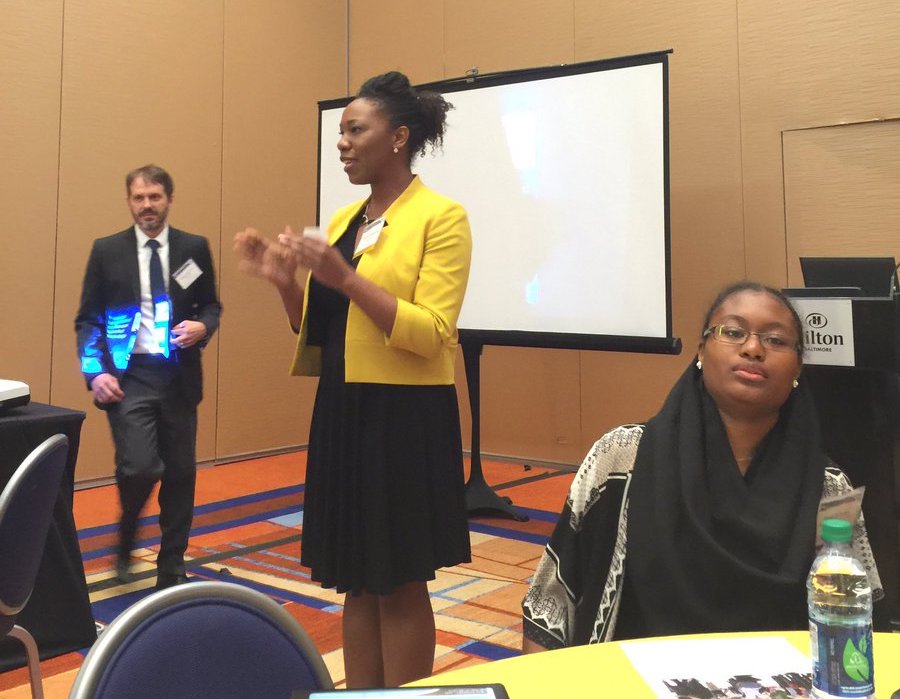
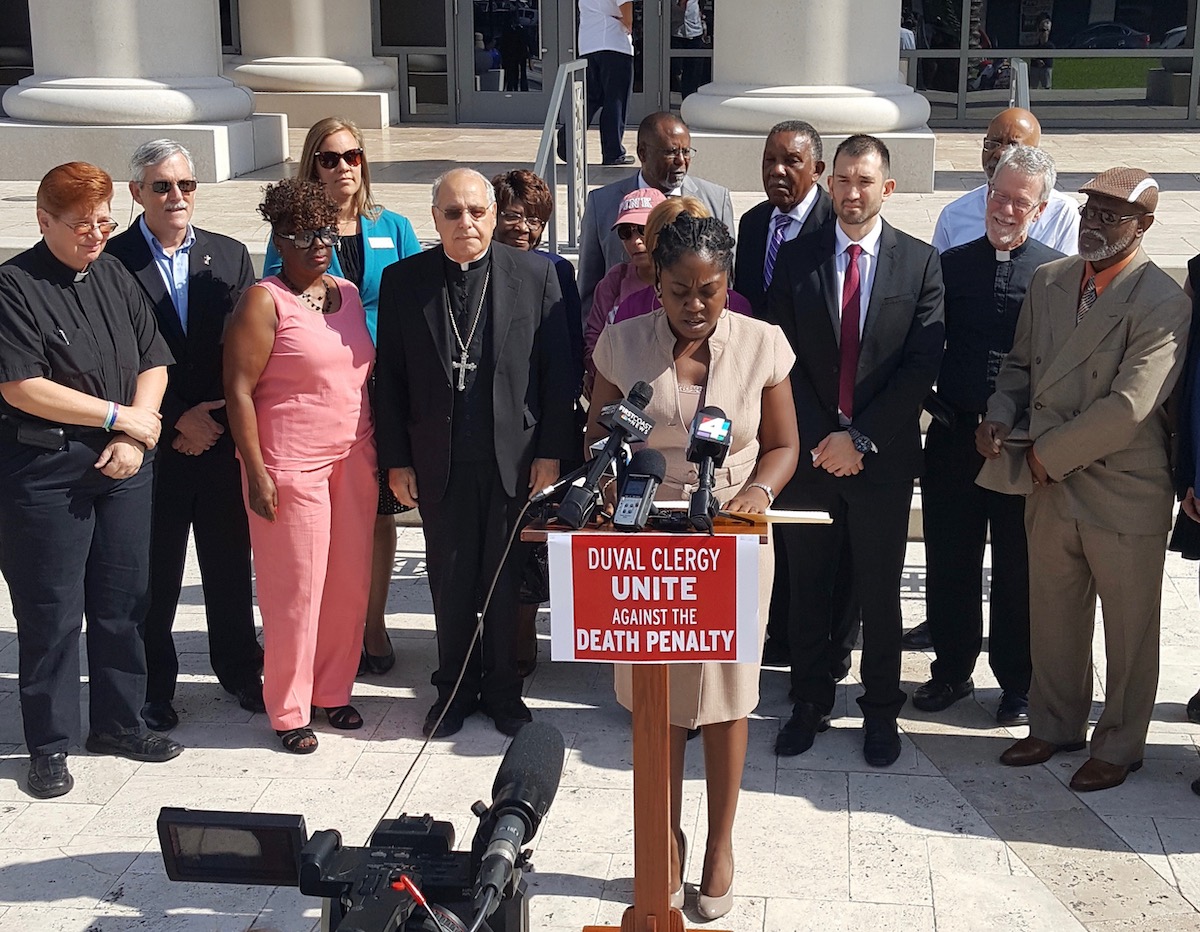
Christine speaks at a press conference at the Duval County Courthouse

More than 20 Duval County, Florida, religious leaders participated in an EJUSA press conference in front of the County Courthouse today. They gathered in reaction to a report from the Fair Punishment Project branding Duval County an “outlier” in its overuse of the death penalty. Clergy released a letter to the State Attorney’s Office signed by over 50 religious leaders from throughout the region, demanding a halt to death penalty prosecutions in their county.

“Duval County represents everything that is wrong with the small and shrinking number of counties that are still using the death penalty in America,” said EJUSA Executive Director Shari Silberstein. “They all suffer from overzealous prosecutors, ineffective defense lawyers, and racial bias, which helps to explain why Florida leads the nation with 26 death row exonerations.”

EJUSA’s Jacksonville-based organizer, Christine Henderson, facilitated the news conference, which included the Bishop of the Catholic Diocese of St. Augustine, the Most Reverend Felipe Estévez, as well as Pastor Reginald Gundy of Mt. Sinai Missionary Baptist Church, and several others.

“The overzealous pursuit of the death penalty has become a symbol of our racist and broken criminal justice system, and now we have confirmation that Duval County is in fact one of the worst of the worst,” said Pastor Gundy. “There is no escaping our outlier status when many other Florida counties are beginning to turn away from the death penalty.”

Bishop Estévez also expressed concerns: “Whenever we can choose life over death, we are called to so. Duval County’s high use of the death penalty raises grave concerns and goes completely against promoting a culture of life, since means other than execution are available to keep society secure.”

Filed under: Ready for launch

Trauma-Informed Responses to Violence and Criminal Justice: An Interview with New Jersey Asst. Attorney General Wanda Moore

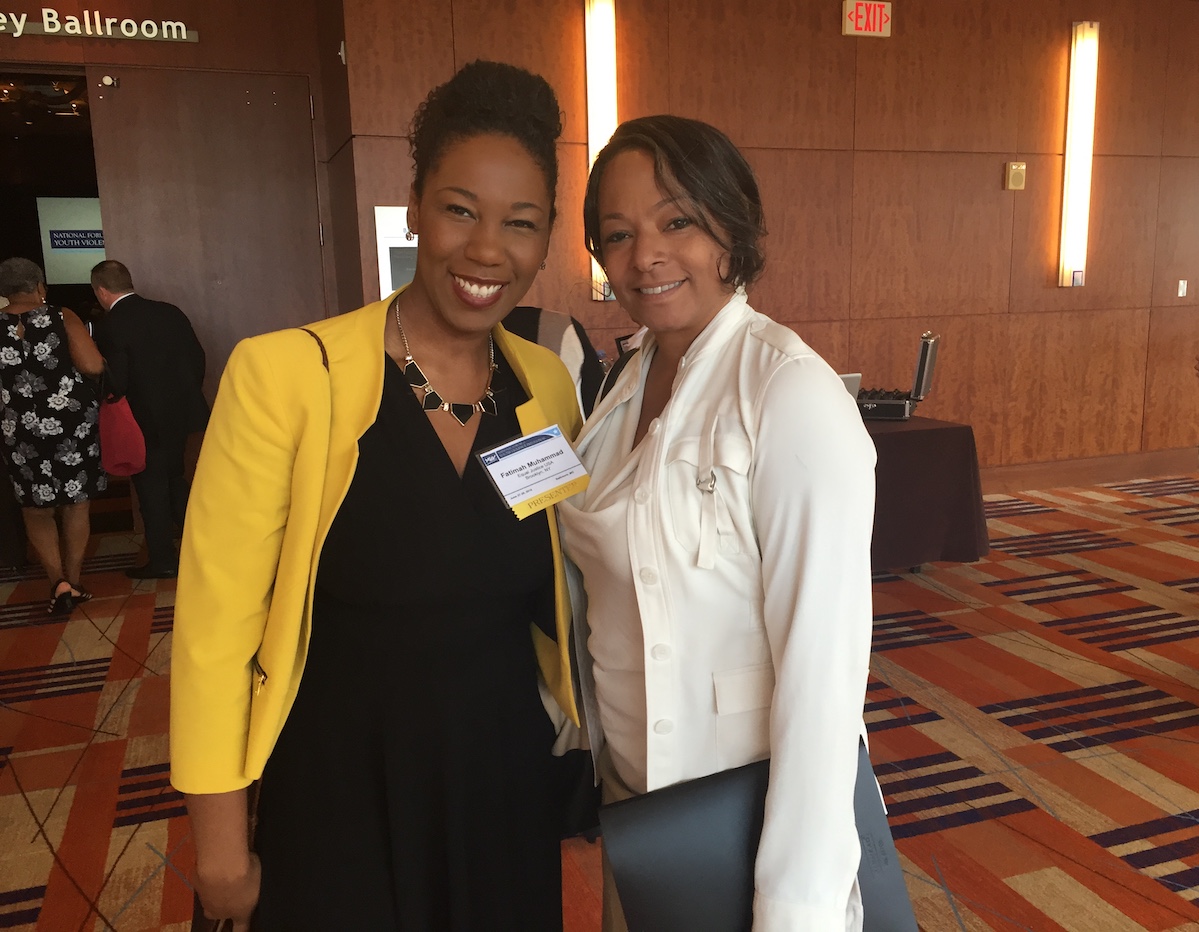
Fatimah & Wanda Moore

Recently I spoke to Wanda Moore, an Assistant Attorney General in New Jersey and the Director of the Office of Community Justice, about her work to reduce trauma and violence through positive youth development programs, community-based crime prevention strategies, and system wide change. Ms. Moore leads cutting-edge, place-based solutions work in several cities in New Jersey including Trenton, Jersey City, and Newark. She attended EJUSA’s 2-day trauma train-the-trainer for criminal justice professionals in April, made possible by the generous support of the Healthcare Foundation of New Jersey.

(Note: This interview has been edited and condensed for clarity.)
 

Fatimah Loren Muhammad: Thank you so much for speaking with me. What does a trauma-responsive justice system mean to you?

Wanda Moore: The overwhelming majority of people in the system are in the system because of some trauma they have experienced and their inability to cope with it. As a result, they may be using drugs, not taking care of themselves, or their mental health status may be impacted.

If I take the system of incarceration – which says, “Now the cost you are going to pay for this is 3-5 years, and I put it aside for the moment, something powerful is possible. Instead, if the Court and the legal professionals ask, “what happened to you?” then we can use our best data and evidence to develop a plan that can help them. At the same time, we can relay the message that this behavior is not appropriate, but since your trauma is driving it, here is what we can do to help. This is where being trauma informed improves criminal justice system responses.

When we understand context, we can realign resources. From my experience with drug courts, I watched as our response to treatment and being clinically driven changed the system. The whole system then changes because it becomes driven by the science of what we know around trauma. It becomes driven around responses that make more sense, and limited resources become more effective. We literally can change the world by making the criminal justice system more trauma-informed. That will impact other systems by making them more forward thinking and results driven.
 

FLM: In Newark, you participated in EJUSA’s trauma train-the-trainer, which was the first step in our larger project to support Newark Police Department and community leaders to identify trauma-informed responses to violence. What did you take away from that training?

WM: For awhile, I felt like we were not hearing one another. But then there was this moment where everyone began to listen and understand each other. You have got to hear one another for this to work. All of the stakeholders – faith leaders, public health, community violence prevention folks, victims – were very interested in hearing law enforcement’s perspective and likewise.

I’m very hopeful. Law enforcement is and wants to be more involved in the community and attributes value in being more trauma-informed. You heard the officers – some of them were born and raised in Newark and questioned when did they become the enemy? People needed to hear that. They wanted to convey the message that “I am you.” I have had the same or similar experiences.

Recently, I incorporated portions of the training in a workshop I facilitated at the National Consortium on Racial and Ethnic Fairness in the Courts. The concept connected with attendees in the breakout groups. This was a great exercise with the judicial staff. They started to engage in dialogue regarding trauma like you and I would.

FLM: That sounds incredible. And you do so much more in the state of New Jersey. Tell me more about your work statewide on trauma and the cycle of violence.

WM: I am working on aligning federal, state, and municipal resources so that there is effective coordination and common goals. I promote collective impact by working across many cities (about 13) and focus on local youth planning and policy boards. We have to be creative about how to reach the “at-risk” or opportunity youth because they aren’t disconnected – we are.

My office is committed to bringing actual community change. We work toward outcomes and evaluate our performance. We stay connected to grassroots efforts. In the communities that we engage, we work to connect all the dots. If we are not changing systems or policies, we are not going to have lasting impact.

FLM: What trauma work is happening in the state that most excites you?

WM: I’m very excited about all of the great work on the topic. EJUSA is doing great work. Hopeworks in Camden is doing great work by engaging youth to address trauma. The Trenton Health team is doing great work helping the nonprofit community become trauma-informed. Professor David Troutt, Director at the Center on Law in Metropolitan Equity at Rutgers Newark co-hosted with us a roundtable of trauma experts in April 2016 to talk about trauma and education, which was highly informative. Other partners, like the Robert Wood Johnson Foundation, are supporting these efforts.

What is most exciting is that New Jersey is moving towards its own trauma-informed system of care. For example, Boston, Massachusetts has moved forward with their model of trauma-informed care. Under the leadership of Courtney Grey of the Boston Health Department, their trauma-informed care model embraces grassroots level of community engagement. I am inspired by the work of Mr. Grey, Joshua Durand, and many others. I am excited about developing a similar trauma-informed care model at the grassroots level within our state. My goal is to bring together our government partners with trauma-informed providers on the ground to create community-wide trauma-informed responses. I am delighted to have this opportunity to move this work forward in New Jersey.
Filed under: Ready for launch

The crippling costs of Nebraska’s death penalty

Nebraska Cost Study Infographic

A study of the cost of Nebraska’s death penalty concluded that the state could save $14.6 million per year if Nebraskans vote to end the death penalty in November.

Dr. Ernie Goss, professor of economics at Creighton University, said he was surprised when his study revealed how expensive the death penalty is compared to its alternatives.”If you care about economics, you should vote to Retain the end of the death penalty in November,” he said at a news conference to present the comprehensive study.

Dr. Goss has conducted several studies for the Platte Institute for Economic Research, a free market research and educational think tank in Nebraska, founded in 2008 by Pete Ricketts. Ricketts is now Governor of Nebraska and one of the leading proponents of the campaign to “repeal the repeal.”

Download the full report here.

Nebraska Cost Study Infographic

Filed under: Ready for launch

National survey reveals victims’ views on criminal justice priorities

Crime Survivors Speak Report from ASJ

There is an assumption that justice means punishment for someone who has done something wrong: a crime happens, law enforcement finds out who did it, the courts hand down a sentence, and the crime victim is healed.

But we know from our work with crime survivors over the last decade that the reality is much more complex. Hundreds of crime survivors have told us about their many needs that have nothing to do with what happens to the person who harmed them. A new survey released by the Alliance for Safety and Justice (ASJ) puts data behind that knowledge.

The “Crime Survivors Speak” survey reveals that 61 percent of crime victims support shorter prison sentences and more spending on prevention and rehabilitation to long prison sentences. And by a margin of 3 to 1, victims prefer holding people accountable through options beyond prison, “such as rehabilitation, mental health treatment, drug treatment, community supervision, or community service.”

The survey also found that 8 of 10 survivors experience at least one symptom of trauma in the aftermath of the incident that harmed them. Two out of three of those surveyed received no help following the incident, and those who did were far more likely to receive it from family and friends than from the justice system.

Visit ASJ’s website to read the full report, including graphics and videos outlining the survey’s findings.

Filed under: Ready for launch

The death penalty’s role in racial oppression

National Archives, Records of the U.S. Senate, Records of Rights
National Archives, Records of the U.S. Senate, Records of Rights.

Race has played a disturbing role in the death penalty’s application throughout its long history in the United States. During slavery, this discrimination was explicitly written in many states’ laws. Blacks and slaves faced the death penalty in cases where the same crime committed by a white person would not even be eligible for death. For example, in Virginia before the Civil War, there were over 60 capital crimes for slaves but only one – murder – for whites. Executions became so closely tied to the punishment of blacks in some regions that executing a white man was, according to one local account from Virginia, a “strange spectacle.”1

The 14th Amendment made these black-only capital crimes unconstitutional. But racial bias still continued in practice during the Jim Crow era. Some saw the death penalty as a necessary response to what they believed to be the inherently violent nature of black people. George Hays, Governor of Arkansas, for example, wrote in 1927 that states needed the death penalty to address the “negro problem.”2

Black defendants often received little due process, as trials and executions sometimes both took place in a single day. This expedited system could blur the line between executions and lynchings. As lynchings declined in the first part of the 20th century in response to mounting criticism, executions became more common, in effect replacing lynching as a tool of racial violence against African Americans.3

George Stinney mugshot, 1944
George Stinney mugshot, 1944, public domain.

Capital punishment’s youngest victim during this era was George Stinney, a 14-year-old African American executed in South Carolina in 1944. After a two-hour trial and only 10 minutes of deliberation, an all-white jury sentenced Stinney to death for the murder of two white girls. The testimony of an alibi witness and other evidence now point to Stinney’s innocence, which resulted in him receiving a posthumous exoneration in 2014 – 70 years after his execution.4

The statistics back up these examples of racial inequity. A full 75% of those executed in the South from 1910 to 1950 were black, even though black people were less than a quarter of the South’s population.5 The racial disparities for certain crimes, such as rape, were especially stark. Of the 455 men executed for rape in the U.S. between 1930 and 1967, 90% were black.6

The biased and arbitrary application of capital punishment led the Supreme Court to declare it unconstitutional in 1972. In response, states rewrote their death penalty statutes to create more consistency in death sentencing. After reviewing these revised statutes, the Supreme Court allowed the death penalty to return in 1976. But – not surprisingly – the revised death penalty laws failed to eliminate racial bias as promised.

The race of the victim has a significant impact on who lives or dies. Nationally, less than half (47%) of all murder victims since the 1970s are black. But for cases ending in an execution, only 17% of murder victims are black.7 Such patterns carry the implication that white lives matter more in the justice system. Critical of how the death penalty elevates some victims above others, many murder victims’ families have called for its repeal.8

The issue of racial bias came back to the Supreme Court in 1987 in a landmark case called McCleskey v. Kemp. In that case, the Court considered statistical evidence that those accused of murdering white victims in Georgia were significantly more likely to be sentenced to death than those accused of murdering black victims. The research controlled for dozens of variables besides race that could explain these disparities.

Troy Davis Execution - Wednesday 7:00 pm: Protesters at the Capitol in Atlanta.
The Execution of Troy Davis, September 19-21, 2011, Wednesday 7:00 pm: Protesters at the Capitol in Atlanta, by Scott Langley, Death Penalty Photography Documentary Project.

The Court did not question the research. Yet they denied that such racial disparities violated the Constitution in a close 5-4 decision. The decision’s author, Chief Justice Lewis Powell, later said that his vote to uphold the death penalty in McCleskey was the one vote he regretted during his time on the Supreme Court.9

Clearly, the problems of racial bias present in today’s death penalty are far from new. Attempts to eliminate such bias while keeping the death penalty in place have repeatedly failed. It’s time to end the death penalty – a practice so closely tied to the history of racial oppression in the U.S. – and to address racial disparities in the broader justice system.

Filed under: Ready for launch

Evangelical leaders call upon Texas to stop scheduled execution

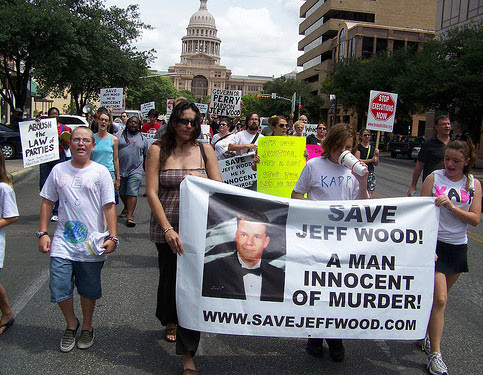
Almost 50 Evangelical leaders from Texas and around the country called upon state officials to stop the execution of Jeff Wood. In a letter released Monday, the religious leaders urged Governor Greg Abbott and the Texas Board of Paroles and Pardons to grant Wood a new sentencing hearing, saying he “never should have been sentenced to death.”

Texas is scheduled to execute Wood on August 24th for his role in the murder of Kris Keeran. But Wood wasn’t even inside the gas station where Keeran was working as the clerk. He was sitting in a “get-away” truck outside. Wood had no previous criminal history and suffers from borderline intellectual functioning and mental illness.

“As the getaway driver, Wood committed a crime, but not one deserving the death penalty,” the letter says. “The death penalty, we are told, is reserved for the most egregious crimes. Wood’s actions – which did not include directly committing a murder or intending to – simply do not fall into this category.”

Signatories include national Evangelical leaders such as Rev. Sam Rodriguez of the National Hispanic Christian Leadership Conference, Willow Creek co-Founder Lynne Hybels, Dr. Antipas Harris of Regent University School of Divinity, and Jay Sekulow of the American Center for Law & Justice. The Baptist Standard also highlighted the several Baptist ministers who signed the letter.

You can read the full letter here.

Wood’s attorneys have also filed an official application for clemency to Board of Pardons and Paroles, who have recommended commutations for two people who, like Wood, did not take a life themselves.

Photo credit: SaveJeffWood.com

Filed under: Ready for launch

Another state ends the death penalty

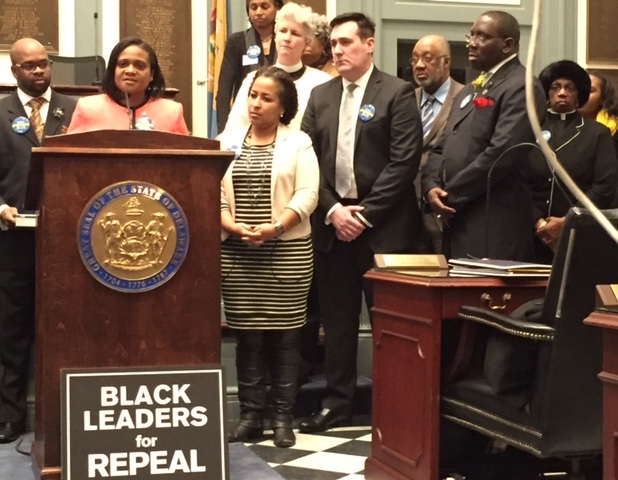
Delaware Black Leaders for Repeal press conference

Yesterday, Delaware’s death penalty was ruled unconstitutional!

“Delaware’s death penalty is gone,” said EJUSA’s Executive Director Shari Silberstein. “It’s only a matter of time before the whole house of cards that is the death penalty in the United States comes crashing down.”

Delaware joins the growing number of states that have abandoned the death penalty – the 19 that have repealed the death penalty (plus the District of Columbia!), the 4 that have a moratorium in place, and the 8 others that haven’t carried out an execution in more than 10 years.

After the General Assembly came close to repealing the death penalty this spring, the Delaware Supreme Court took up the issue. They ruled that the state’s law violates the 6th Amendment to the U.S. Constitution, based on the recent U.S. Supreme Court ruling in Hurst v. Florida. The Hurst decision found that juries, not judges, must ultimately decide whether a defendant should receive a death sentence.

You can read more about the Delaware Supreme Court’s decision here, or tune into our Facebook and Twitter feeds to get the latest.

Thanks for all of your support and efforts, which make celebrations like this all the better.

Filed under: Ready for launch

Building the movement to disrupt the cycle of violence

Fatimah giving workshop via Twitter

Shortly after last month’s tragic mass shooting in Orlando, the American Medical Association declared gun violence a public health issue.

EJUSA believes that this powerful frame applies to all violence. Public health models prioritize prevention, harm reduction, as well as trauma treatment. By completely changing the narrative on violence, its causes, and its solutions, we believe we will truly transform the justice system.

To advance our vision for justice transformation, EJUSA went to the White House to begin that discussion last month. Trauma and violence experts, city health department officials from Boston, Philadelphia, and Baltimore, crime survivors, public health and criminal justice reform advocates, and more joined us for a robust dialogue with federal agents across many agencies. The meeting has already sparked other collaborations and new opportunities for action among participants.

One of those opportunities included EJUSA’s collaborative workshop at the Department of Justice National Forum on Youth Violence Prevention together with Cure Violence, an organization known for its public health violence prevention programs. (You may have seen them profiled in the excellent movie, The Interrupters.)

Our workshop, called Race, Trauma and Disrupting the Cycle of Violence: From Local Programs to Broad Movement, discussed the work of our respective organizations and our contribution to the larger movement to reframe violence. While the violence prevention field has produced so many examples of local programs and initiatives that frame violence as a public health issue, those programs have not been brought to scale. And public understanding of how to address violence is still disconnected from these great programs.

Our workshop sought to bridge that gap by exploring what makes a movement and how to grow this field from local programs to a broad force for change. EJUSA presented our movement building framework, which includes six elements:

  1. Data and research on the problem and its solutions
  2. Proof of concept, or examples of the solutions in action
  3. Narrative shifting that changes the framing and cultural meaning of an issue
  4. Campaigns to change policies or systems at the local, state, and federal levels
  5. Grassroots capacity building that builds leadership of those most impacted
  6. National coordination

Many of the local programs in the workshop were able to see their excellent work as examples of #2 – proofs of concept. Their programs show the world what’s possible, and inspire people to believe that solutions work. It is then up to advocates to work with practitioners and impacted communities to lift those models through communications and campaigns, so they can be replicated and expanded. By understanding how advocates’, practitioners’, and communities’ work complement each other, it is easier to imagine a cohesive movement where all the pieces are working in coordination.

The movement building workshop punctuated a powerful set of main-stage speakers who highlighted both challenges and success stories in education, crime prevention, trauma response. Sessions highlighted the unique needs of young men of color, as well as the broader challenge of racial bias in transforming our responses to violence. Jet Magazine’s story of the Summit features EJUSA’s Trauma Advocacy Initiative Director, Fatimah Loren Muhammad.

Filed under: Ready for launch

State courts wrestle with U.S. Supreme Court death penalty rulings. Now up: Delaware!

Delaware Black Leaders for Repeal press conference

On June 16, 2016, the Delaware Supreme Court heard oral arguments on Rauf v State, a case that will decide the future of Delaware’s death penalty. This case is the latest ripple effect from the U.S. Supreme Court’s Hurst v Florida ruling earlier this year, which struck down Florida’s death penalty and impacts other states, including Delaware.

The Delaware Repeal Project, Murder Victims Family Members for Reconciliation, and Delaware Citizens Opposed to the Death Penalty worked together to organize a silent vigil outside the court, and packed the courtroom in Dover as lawyers argued the constitutionality of Delaware’s capital sentencing statute. Repeal supporters from across the state bore witness to the proceedings, showing the strong support for ending Delaware’s broken and possibly unconstitutional death penalty.

Why Delaware? Why now?

In January 2016, the U.S. Supreme Court ruled in Hurst v Florida that Florida’s death penalty was unconstitutional because it minimized the role of juries in deciding death sentences. The Constitution’s Sixth Amendment guarantees a trial by jury, but under Florida’s stricken death penalty law, the jury’s decision between the death penalty and life without parole is only a non-binding recommendation to the judge. Hurst is the latest in a series of decisions by the Supreme Court making clear that a jury, not a judge, must determine whether a crime warrants death.

Hurst matters to Delaware. Delaware’s statute isn’t a mirror of Florida’s old one, but both states, as well as Alabama’s, share qualities that make them outliers compared to the rest of the country. Delaware and Alabama (and previously Florida) are the only states where juries’ sentencing recommendations are not binding and are not required to be unanimous. That’s why the Delaware Supreme Court halted executions and active death penalty cases immediately following the Hurst decision, so they could explore the impact of Hurst on their state’s law.

During the June 16 hearing, lawyers sparred with the justices on how Hurst impacts Delaware’s death penalty, at times wading into the legal weeds of what the Sixth Amendment guarantees really mean. Predictably, the State argued that the impact of Hurst is narrow and Delaware should get back to the business of executing. Lawyers for the defendant argued that Hurst, in conjunction with previous U.S. Supreme Court decisions, renders Delaware’s capital sentencing scheme unconstitutional.

It’s a nail biter until the court rules!

It’s difficult to predict how the court will decide. Courts rule on their own time, so we have no way of knowing when the decision will come down. But we do know that these arguments were fast tracked, suggesting the court will rule in 30 – 90 days. Until then, cases stay on hold and all eyes remain on the Delaware Supreme Court.

Filed under: Ready for launch