Category: Ready for launch

Year-end report of 2016 shows continued decline

DPIC 2016 End of Year Report

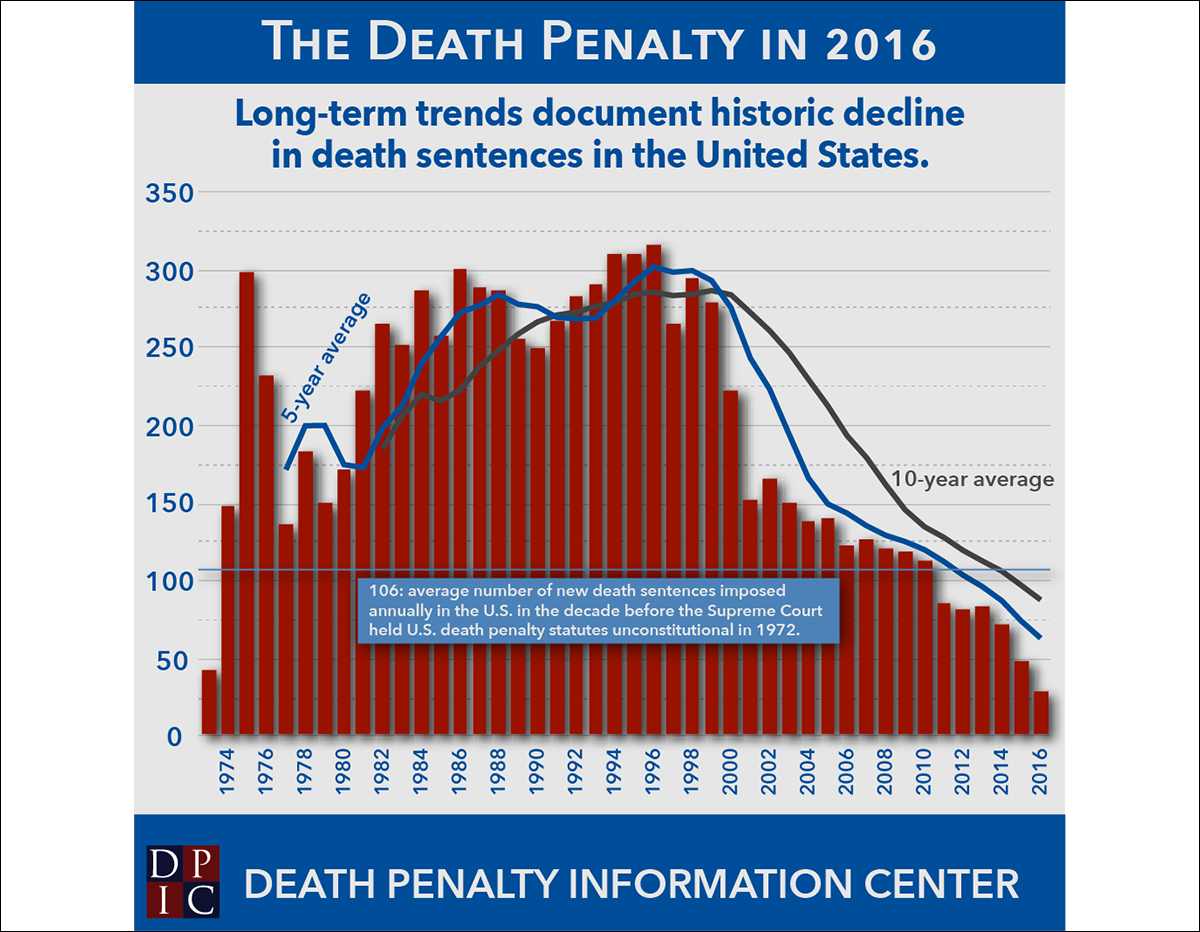
The death penalty continued its historic decline in 2016, according to the year-end report put out by the Death Penalty Information Center. The report found:

  • The number of death sentenced imposed by American juries was lower than in any other year since the reinstatement of the death penalty in 1972. The 30 death sentences from 2016 represent a 39% decline from 2015’s already 40-year low of 49.
  • Executions declined by more than 25% from 2015, and, together, Georgia and Texas executed 80% of the 20 men executed in 2016.
  • Public opinion polls in 2016 reported historic lows in support for the death penalty.
  • State Courts in Delaware and Florida ruled that the death penalty laws in their states are unconstitutional.
  • Prosecutors in four of the 16 counties that impose the most death sentences in the U.S. were defeated by candidates who expressed personal opposition to the death penalty or pledged to reform their county’s death penalty practices.

Check out the full report, and help spread the word about the death penalty’s demise.

Share New York Times‘ story about the dying death penalty with your friends on social media.

Click here to share on Facebook Click here to share on Twitter


Filed under: Ready for launch

Our Impact

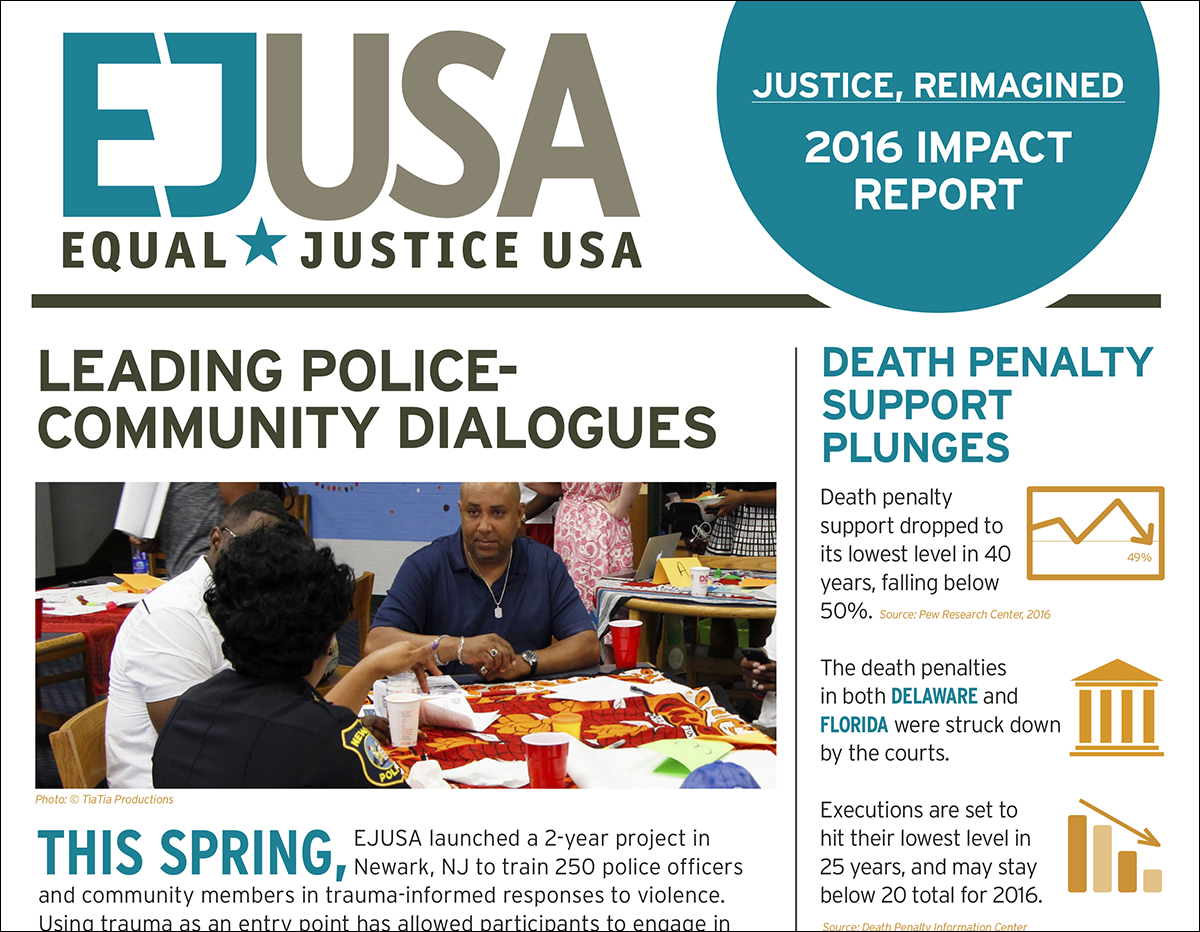
It is with great pleasure and deep gratitude that I share with you EJUSA’s 2016 Impact Report.

As you read it, please remember this: EJUSA’s impact is your impact.

Click here to read the report.

This year’s report highlights how far EJUSA has come on our oldest program – ending the death penalty – and on our exciting program to support community-based groups working with people of color harmed by violence. It also features highlights from year one of an important project of our Trauma Advocacy Initiative: to facilitate a two-year dialogue and training on trauma, racism, and justice with 250 police and community members in Newark, New Jersey.

You made this work possible. Together we’re taking down the broken parts of the justice system like the death penalty, and beginning to build the new, healing justice system of the future.

It’s not too late to help EJUSA reach our $40,000 goal for our year-end fundraising campaign. Please consider a stretch gift as we go into a critical year for our work together. All gifts will be matched through December 31.

Filed under: convert to publication, Needs new photo, Ready for launch

Black lawmakers call for repeal of death penalty

NBCSL Conference

African American State Legislators Cite Disproportionate Sentencing

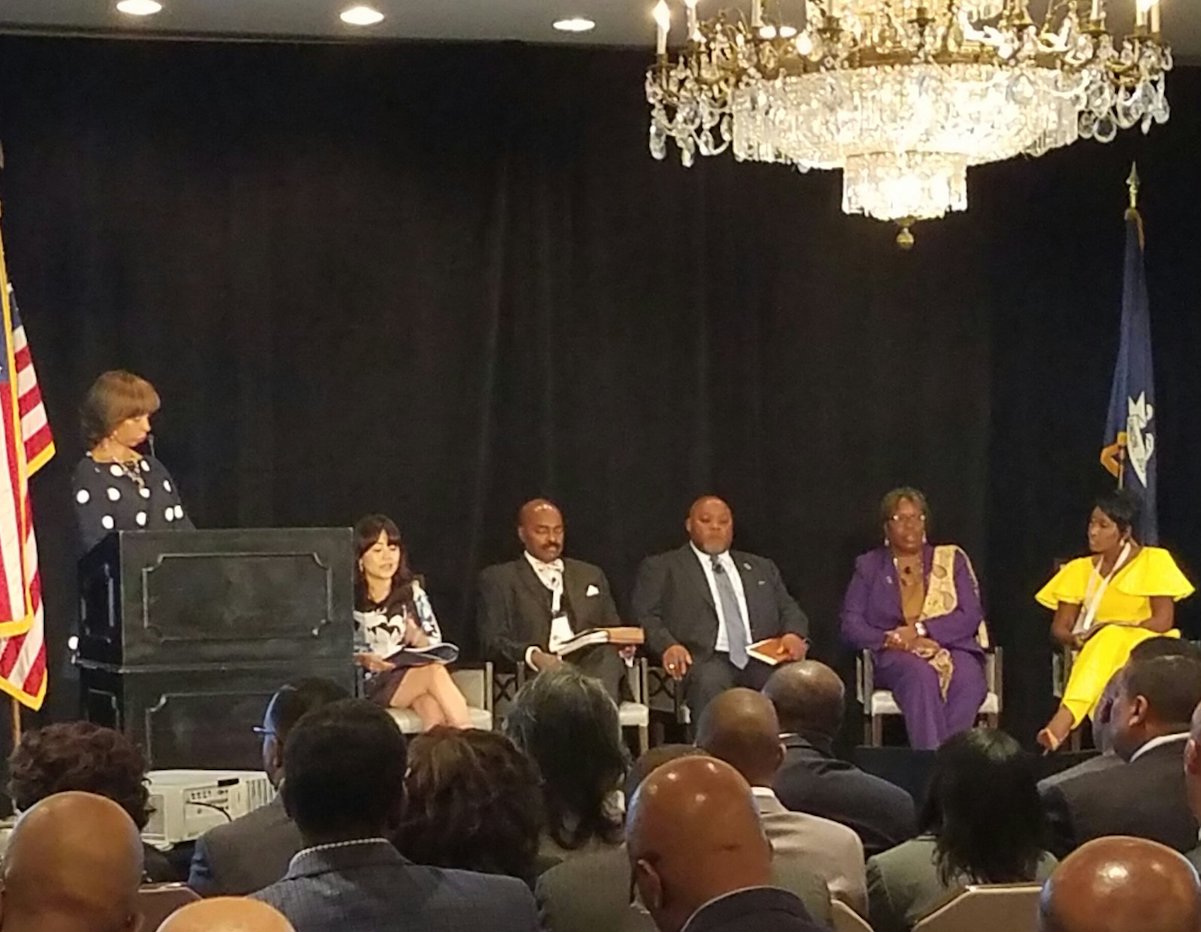
The National Black Caucus of State Legislators (NBCSL) has passed its first-ever resolution supporting repeal of the death penalty in the United States. The historic vote took place during the NBCSL 40th Annual Legislative Conference in New Orleans, LA. It is an escalation of the organization’s previous call for a moratorium in 2002.

“As a Nebraska state senator, I proudly voted to strike the death penalty from our state statutes in 2015. I was just as proud to sponsor the recent NBCSL resolution that calls for an end to the death penalty across the country,” said Nebraska State Senator Tanya Cook. “This sentence is not a deterrent to violent crime. Period. That fact has been scientifically-demonstrated over and over again in this country and around the globe.”

Legislators reviewed the evidence of race being a factor in use of the death penalty, including:

  • African Americans represent only 13.3 percent of the U.S. population but 34.6 percent of those executed since 1976
  • White victims account for half of all homicide cases but account for 80 percent of cases subject to the death penalty
  • Black jurors are three times more likely to be struck from a jury on a death penalty case with a black defendant

NBCSL’s position joins similar recent statements from the National Hispanic Caucus of State Legislators and the Movement for Black Lives.

“Leaders in the fight for racial justice see the death penalty as a microcosm of a much larger system of injustice,” said Lex Steppling, national organizer for Equal Justice USA. “Everything that’s wrong with the justice system is present in the death penalty, and ending it would be an important step toward dismantling the broken parts of our justice system.”

The National Black Caucus of State Legislators (NBCSL) is composed of nearly 700 Black state legislators across 46 states, the District of Columbia, and the U.S. Virgin Islands. Its primary mission is to develop, conduct and promote educational, research and training programs designed to enhance the effectiveness of its members, as they consider legislation and issues of public policy which impact, either directly or indirectly upon “the general welfare” of African American constituents within their respective jurisdictions.


Photo credit: @NBCSLNews

Filed under: Ready for launch

Newark community and police come together to explore trauma-informed responses to violence

Newark Police/Community Training

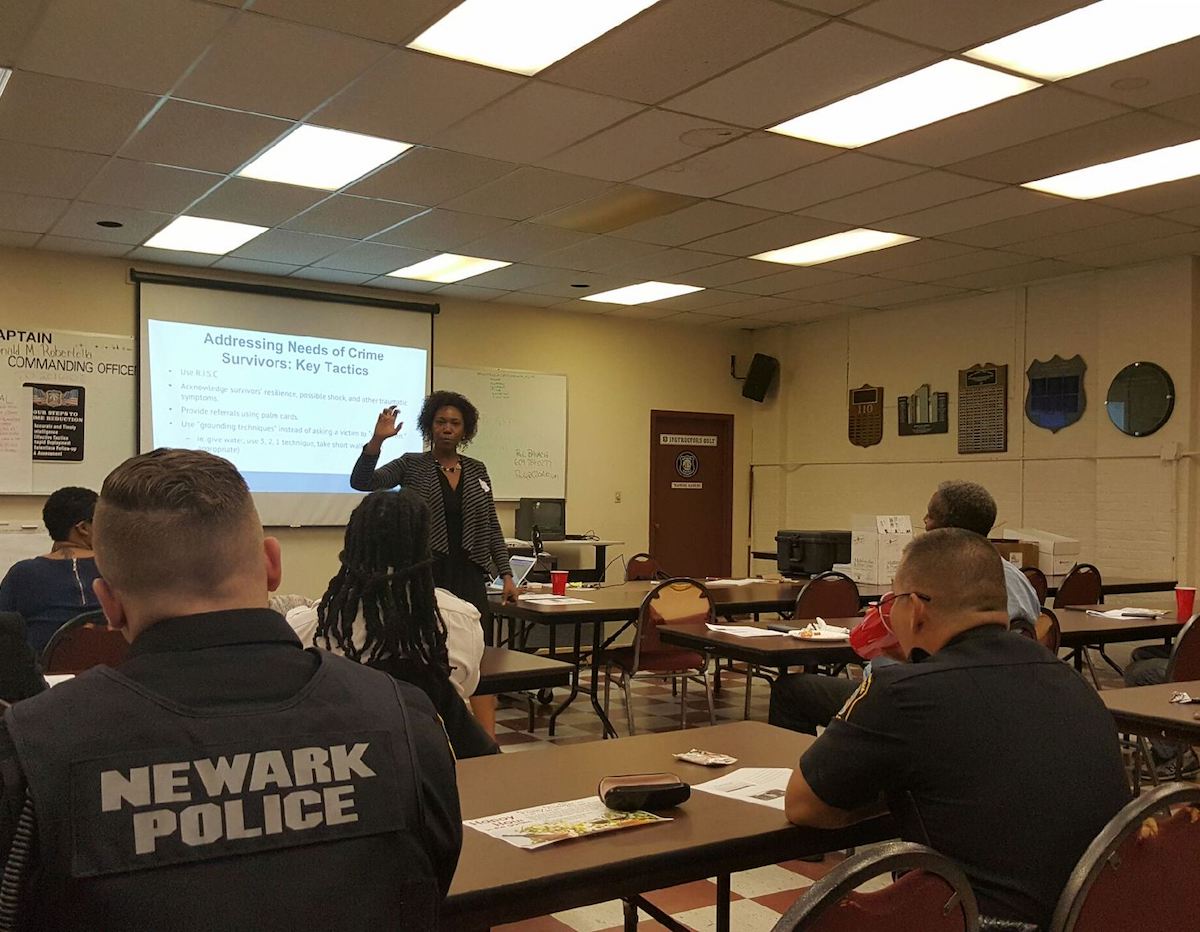
The trauma of police-involved shootings and slain police officers has spurred national and local dialogue, including about racial justice, historical trauma, public safety, police accountability, and much more. This fall, EJUSA’s Trauma Advocacy Program spearheaded a new project to help facilitate even more dialogue – and develop solutions – in Newark, New Jersey.

“Trauma-Informed Responses to Violence: Police/Community Training Initiative”1 has brought over 150 police officers and civilians together to learn and speak openly about their own trauma, the trauma they see around them, and the historical link between our current justice system, racial oppression, and slavery. With EJUSA staff and EJUSA-trained facilitators, small groups of 20-30 participants, police officers, residents, violence interrupters, social workers, and justice-involved citizens began to talk through the persistent obstacles to trust in the community and began the work of building mutual understanding.

The results have been deeply moving and transformative.

“What I have found most powerful about this training is its ability to allow for both police and community members to see trauma on all sides,” said Trauma Advocacy Project Director Fatimah Loren Muhammad. The idea that trauma is experienced by people throughout the criminal justice system was recently explored in a Washington Post op-ed by James E. Johnson.

EJUSA’s training2 uses trauma as a frame of analysis to surface questions of racism, trust, and ways to listen and empathize. Alongside this powerful work, participants learn trauma-informed skills that help them not only understand the link between healing trauma and reducing violence, but also to work together to reimagine the justice system.

Voices from the Training

Several officers described the trauma of responding to consecutive, horrific crime scenes. One officer shared, “I can go a few days straight seeing dead bodies. That’s just how it is. You don’t have time to process because you have to go to your next call.”

Another officer described responding to a call in which one of his own family members was nearly shot and killed. After securing the scene, he had to move on to the next call.

Civilians were shocked at the limited number of supports in place for officers who witnessed violence at such a high level. They understood and worried that, when officers experience trauma, it may impact their health as well as the use-of-force decisions they might make in the field.

Community members also shared stories about being stopped by officers and situations they found hostile. Many see a badge and fear for their lives. Some have been approached by officers with guns drawn, told by officers that their complaints are false, or routinely stopped by police.

One community member, upon sharing a personal story, concluded, “It is hard to live in a community in which the people who are supposed to keep us safe are the ones I fear.”

This message resonated with some officers, one of whom said, “I didn’t realize that my badge could be traumatizing for someone else. Just my badge. Even when I am walking to someone to offer help, it doesn’t occur to me that they could be scared.” Officers recognized that acknowledging the current and historical trauma in communities of color can go a long way in interpersonal interactions.

While individual interactions are important, the training also addressed systems. Using their understanding of trauma, officers and community members worked in teams to reimagine a trauma-informed justice system. As the teams presented, one officer deftly shared, “I have arrested some of the same young men over and over again. Prison becomes a revolving door for them. It’s just not working. I would much prefer they get some support for their trauma early on. It just makes more sense.”

At a time when the nation is grappling with the seemingly intractable issues of racism and trust among officers and communities of color, we are cautiously hopeful when we reflect on what’s possible when participants come together with courage, vulnerability, and openness to find common ground. These are the seeds of powerful, meaningful change.

A report summarizing the findings from the trainings and recommended principles of trauma-informed policing will be released in 2017.


Filed under: Ready for launch

Recharging for the Long Haul

Here at EJUSA we don’t often share the inner workings of our organization, posting instead about the issues that drive our mission and the changes we seek — and that you want to see — in the justice system.

But our inner workings make me equally proud to be part of EJUSA, because we work hard to reflect our values there too. That means all kinds of things, for example:

  • Making time for our team to bond and connect so that we can do our best work together.
  • Committing to racial equity, and investing in the internal work required to get there.
  • Avoiding unnecessary educational requirements when we hire, so we don’t overlook excellent people who haven’t had access to those opportunities.
  • Building a team that is politically diverse, even when it’s hard.
  • Hiring people who’ve had direct experiences with the issues we work on.
  • Supporting our staff with good benefits, flexible work hours, and family-friendly work arrangements.
    Encouraging time for staff to take breaks, recharge, and build balance into their lives.

That last point is one of the hardest for us, because the fights are so big and we care so deeply. But it is also the most important — because there are no quick wins in the fight for justice. All of us — staff, volunteers, activists, donors, supporters — need to pace ourselves because this is the work of a lifetime.

So, I am humbled and privileged to share that I’m taking a sabbatical for the next four months, an incredible opportunity. I’ll be back to work on April 5. While I’m gone, our work will continue. My two brilliant colleagues, Laura Porter and Jason Zahorchak, will take the helm as Acting Co-Directors.

During my time away, I hope to reflect on my 16 years with EJUSA, where we’re going next, and how I can be an even better Executive Director when I return. I’m excited to rest, learn, grow, and recharge for the road ahead.

I’ve heard from many of our supporters how worn out you are by this election, the uneasiness you feel about the work ahead, and the fear you’re living with as our nation’s public rhetoric feels more divisive, racist, and hateful.

The coming years will require all of us to be even bolder in our vision, more creative in our strategies, and more decisive in claiming the values we stand for, like racial equity, healing, bridge building, and justice that is truly responsive and accessible to all.

This the fight in front of us.

I am excited to see what new ideas emerge at EJUSA while I’m away, and to take our collective struggle into its next chapter when I return. I remain deeply grateful for the unwavering support and partnership of the entire EJUSA family, including you.

Filed under: Ready for launch

Healing the wounds of violence in Detroit

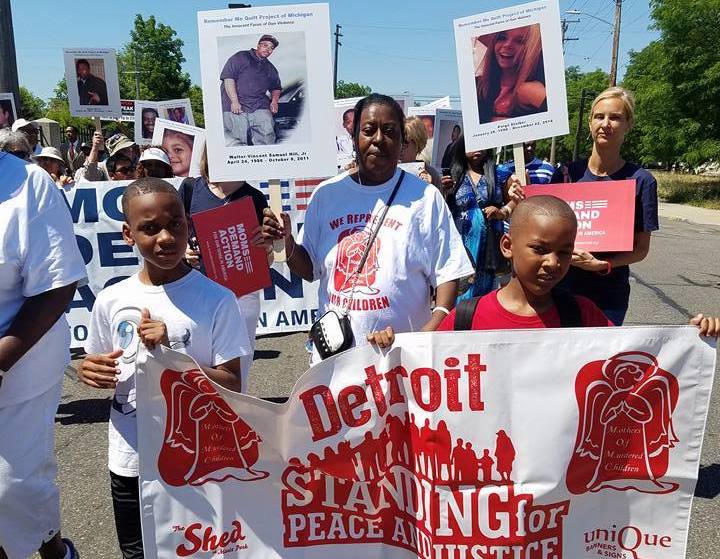
Mothers of Murdered Children March for peace in Detroit

Since its founding more than 5 years ago, Mothers of Murdered Children Detroit (MOMC) has provided support, advocacy, and healing services to mothers and families who have lost loved ones to violence. From helping with funeral arrangements and facilitating grief support groups, to accompanying families to court and helping grieving grandmothers gain legal access of their grandchildren, MOMC is there for families who are trying to rebuild their lives after surviving violence.

EJUSA has been giving technical support to MOMC for several months, helping them build their capacity and prepare to apply for VOCA funding. Grassroots Capacity Building Specialist Latrina Kelly-James helped them organize all of their services and support into a program model, worked with them to create a client tracking system, developed program narratives, and coached the staff on building relationships with local and state resources.

MOMC and Andrea Clark, its dynamic and passionate Founder and Executive Director, are driven to get the resources they need to continue their work and to help even more people in the community. They recently partnered with the Detroit Police Department to solve cold cases, and they have secured office space in the heart of the Detroit community. They continue to build their reputation as the go-to organization for people in search of healing and action against violence.

MOMC’s growth over the past six months has been amazing, not just in utilizing the tools EJUSA has provided, but also in the confidence they have rightfully gained in knowing the impact of their work on the larger Detroit community.

“I have been in a room with their volunteers, all mothers who’ve lost children,” Latrina reflected. “They stand and talk about the grief and pain of losing their child, and they also light up when they describe how MOMC is the only organization that really understands their pain and continues to help them.

“Their work is much deeper than just providing services. These women have created a voice for mothers whose children are often seen, even in their death, as being responsible for their own harm.”

Having lost her own son to violence in 2011, Clark is not only an advocate, but also a survivor. She has acknowledged that her son’s death became her calling to help mothers through the grieving process, to navigate the court system, and to foster a healing community. These have all become part of her own personal healing.

“It has been a blessing to work with EJUSA,” Clark said of her work with Latrina. “With her assistance, we have been able to identify areas of weakness in providing services to families impacted by violence, and that gave us the opportunity to strengthen those areas. Latrina has been personable, very patient and freely gives advice, which was so necessary for us.”

Like many grassroots organizations, MOMC’s services and support have not yet translated to sustainable funding. Through the capacity-building and technical assistance model, EJUSA is arming MOMC with the tools to not only get VOCA funding but also to pursue other fundraising efforts. It’s about building on the foundation MOMC has laid.

We look forward to keeping you posted on MOMC’s growth and their impact on healing in Detroit.

Filed under: Ready for launch

24 hours can go really fast

#GivingIsHealing

#GivingTuesday is 24 hours of giving, but time flies when you’re giving the gift of healing.

There’s just a few more hours to help EJUSA’s #GivingIsHealing campaign succeed.

Please make a tax-deductible donation to EJUSA before midnight tonight, and be part of the #GivingTuesday global day of giving. A generous donor will double all gifts up to a total of $20k!

In these final hours of our #GivingIsHealing campaign for #GivingTuesday, please know how deeply grateful we are for your partnership as we work together to transform the justice system from one that harms to one that heals.

Help us take down harmful policies like the death penalty and shift the focus of the justice system to healing, restoration, and safe communities. Your gift today will be doubled!

Filed under: Ready for launch

#GivingIsHealing

#GivingIsHealing

Today is #GivingTuesday, a global day of giving that reminds us that kindness, compassion, and generosity are among the most important gifts we can give.

It’s also a wonderful opportunity to invest in organizations that reflect these values – the same values that led you to EJUSA and our work to transform the justice system from one that harms to one that heals.

Give the gift of Healing this #GivingTuesday with a tax-deductible donation to EJUSA’s #GivingIsHealing campaign. Thanks to a generous donor, all gifts will be matched up to $20k!

Because of you, EJUSA is engaging a new national conversation about justice. Together, we’re taking down policies that aren’t working like the death penalty, and putting the focus where it should be, on healing, restoration, and safe communities.

On this special day for giving back, please consider a gift to EJUSA.  And remember: every dollar you give today will be matched! #GivingIsHealing

After you donate, help us spread our #GivingIsHealing message even further by sharing this email with family, friends, and networks. And remember, every gift is tax deductible.

Thank you for your trust, generosity, and partnership.

Filed under: Ready for launch

Share a vision for justice that heals

What the death penalty taught me about trauma, healing and justice

Last week, voters in three states chose to keep the death penalty, even in the face of progress on other criminal justice reforms. Though these losses pale in comparison to the longstanding and continuing momentum away from the death penalty in the U.S., they reveal just how much our nation struggles with how to respond to violence.

EJUSA’s Executive Director Shari Silberstein presents a path forward with a vision for justice in a column, “What the death penalty taught me about trauma, healing and justice,” published on Virgin.com.

“EJUSA’s campaign to end the death penalty has given us a unique experience changing the narrative around how we respond to the most extreme acts of violence. We’ve learned that the justice system will fail everyone unless it serves everyone.”

Please take a moment to read about EJUSA’s vision for a justice system that heals, and then share it with your friends on Facebook.

Share this article on Facebook

We will continue to work to transform the justice system from one that harms to one that heals: to end the death penalty, strengthen programs that help crime survivors address trauma and rebuild their lives, and promote trauma-informed responses to violence that can save lives and help heal communities. Thank you for being there with us.

Filed under: Ready for launch